Licensed Pool Removal Contractors Serving Los Angeles
Pool removal in Los Angeles requires an LADBS grading permit, published prices start at $10,500 for a partial fill-in and $17,500 for a full removal, and Pool Removal Directory CA lists six CSLB-checked contractors.

Pool Removal Los Angeles: Published Prices and Permit Facts
Los Angeles Pool Demolition Contractors is the only Los Angeles firm that publishes prices, and its two figures are the only public baseline before a written quote. Angi’s Los Angeles cost page reports a wider range of $2,850 to $11,350 for a partial fill-in and $4,550 to $18,200 for a full removal, with an average of $6,816. Contractor quotes in Los Angeles County land nearer the top of the Angi range than its average.
Partial fill-in (pool abandonment)
- Published starting price: $10,500
- Permit: grading permit, LADBS Grading Division
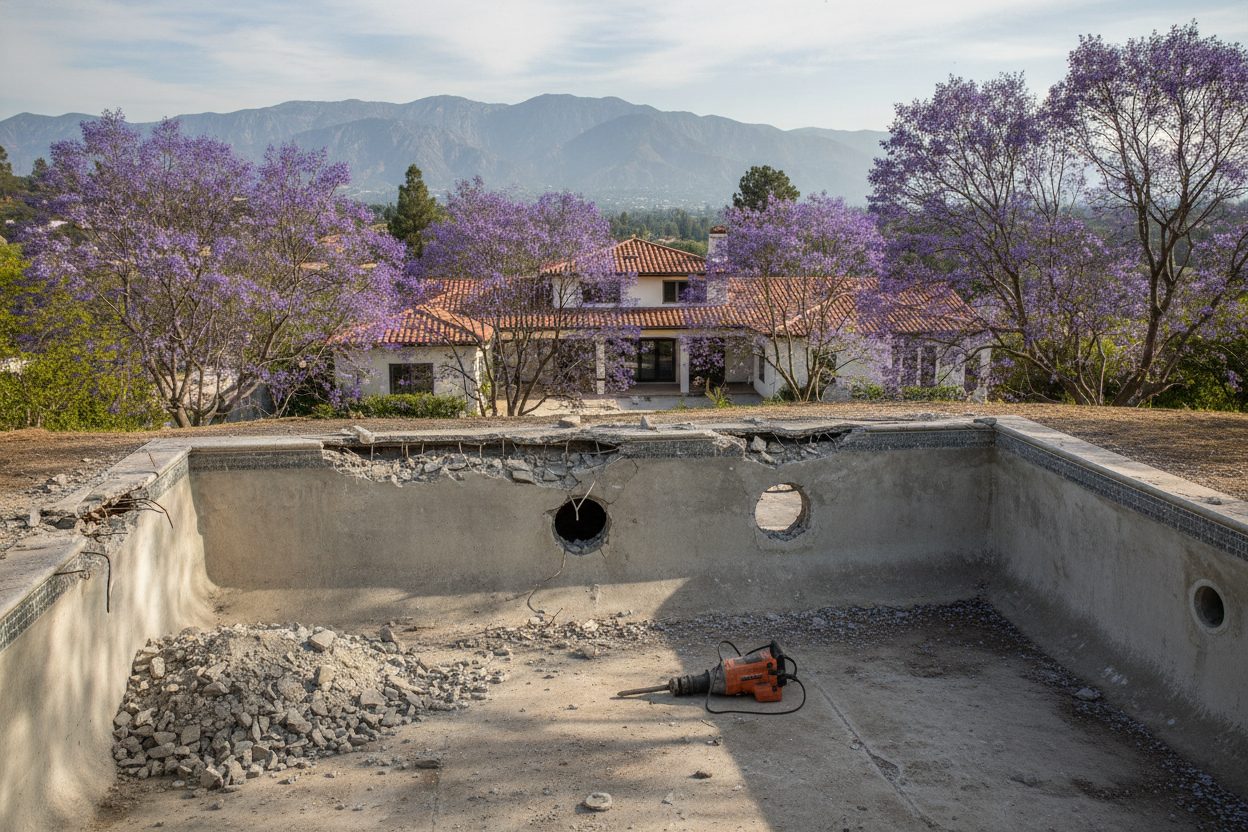
- Scope: drainage holes at least 12 inches wide and no more than 8 feet apart, top of the walls removed, shell filled with clean soil or gravel
- Site work: 1 to 4 days
- After-use: landscaping only, with the fill recorded as uncertified on the plot plan
Full removal (complete demolition)
- Published starting price: $17,500
- Permit: grading permit stating the total cubic yards of fill
- Scope: entire concrete, gunite or fiberglass shell demolished and hauled, fill compacted to at least 90 percent
- Site work: 3 to 7 days
- After-use: buildable once the Grading Division approves the compaction report
Four items move a Los Angeles quote more than pool size does. Side access under 6 feet wide adds about $2,000, and deck removal adds $500 to $1,700. A full removal needs 80 to 150 cubic yards of fill, and the engineer’s compaction report costs $1,500 to $4,000. The California pool removal cost guide sets out every published price by region and pool type.
Licensed contractors serving the city
Pool Removal Directory CA checked every listed license at the CSLB license lookup on 11 October 2026, and businesses with an active license appear first. Each listing names the license number, the license holder and the classes on record. All six hold at least one of the A, C-12 or C-21 classes, with workers’ compensation on file.
Demo Leaders
Demo Leaders is based in Woodland Hills and holds license 1045559 in the B, C-21 and A classes, under Demo Leaders Inc dba Moral Builders. Demo Leaders’ workers’ compensation policy runs to 30 November 2026, so a job starting after that date waits for the renewal to appear on the CSLB record.
Frisch & Sons
Frisch & Sons is based in Villa Park and holds license 696810 in the A and B classes. Frisch & Sons publishes a Los Angeles County pool demolition page and an Orange County price guide, and its workers’ compensation runs to January 2027.
Los Angeles Pool Demolition Contractors
Los Angeles Pool Demolition Contractors is based in Los Angeles and trades under license 1082537 in the B and C-21 classes, held by MVM Grading and Demolition Inc. MVM Grading and Demolition also trades as MVM Pool Demolition & Concrete, Orange Pool Demolition Contractors and San Diego Pool Demolition Contractors under the same license. Pool Removal Directory CA merges the three websites into one listing, and the workers’ compensation policy runs to April 2027.
Shoemaker Demolition
Shoemaker Demolition is based in Ventura County and holds license 1061187 in the C-21, C-12 and A classes, the widest cover among the six listings. Shoemaker Demolition describes its service as swimming pool demolition and removal by certified demolition experts, and its workers’ compensation runs to March 2027.
Suncore Engineering and Construction
Suncore Engineering and Construction is based in Beverly Hills and holds license 1145133 in the A, B, C-8, C-21, C-29 and C-42 classes. Suncore removes in-ground and above-ground pools based on project scope. The C-8 (concrete) and C-42 (sanitation system) classes also cover the deck slabs and drain lines that often sit beside a pool.
Clean Slate Demolition
Clean Slate Demolition is based in Anaheim and holds license 1077186 in the C-21 class. Google Maps lists Clean Slate Demolition for pool removal in Los Angeles, and its workers’ compensation runs to August 2027. Another 9 businesses show no license number or only a Google Maps listing, and the directory checks those by phone before listing them.
License classes LADBS accepts
LADBS generally issues pool removal permits to holders of four classes in the CSLB classification guide: A (General Engineering), C-12 (Earthwork and Paving), C-21 (Building Moving and Demolition) and C-53 (Swimming Pool). A C-53 license is the pool-building class, so a C-53 holder who has only built pools may have little demolition experience. Santa Monica, Beverly Hills and other incorporated cities may accept a different class list. The class is confirmed with the permit office for the specific address before a contract is signed.
Why the $1,000 exemption never applies
CSLB Industry Bulletin 24-07 confirms that the $1,000 minor work exemption does not cover any job that needs a permit. Pool removal in the City of Los Angeles always needs a grading permit, so the work requires a licensed contractor or an owner-builder permit. An unlicensed operator on a pool demolition exposes the property owner to code violations, fines and problems at resale.
Grading permit rules under Bulletin P/BC 2026-111
The Los Angeles Department of Building and Safety treats pool removal as grading work. Bulletin P/BC 2026-111, revised on 2 June 2026, sets out both backfill options. LADBS allows a shell to stay in the ground only on ground sloping 10 percent or less, and only when the area will be landscaped. The partial option needs drainage holes at least 12 inches in diameter, spaced no more than 8 feet apart, with at least one at the deepest point of the shell. The full option needs fill compacted to at least 90 percent relative compaction under ASTM D1557. A soil testing agency approved by LADBS tests that fill and issues a Certificate of Compliance. LADBS publishes no separate fee for pool backfill, and the grading fee follows the scope shown on the plans.
Three city inspections
LADBS calls the same three inspections on both options, each at a set stage of the grading work:
- Initial meeting and inspection, before demolition starts.
- Bottom inspection, after the drainage holes are broken on a partial fill-in or after the shell is out on a full removal, and before any fill goes in.
- Final inspection, once the fill is complete.
A partial fill-in also needs a plot plan showing the pool, its distance to every building and property line, and a note that the fill is uncertified. Uncertified fill cannot carry a footing, so the label limits that part of the lot to planting until the shell is later removed and refilled to the certified standard.
Hillside lots and soils reports
A site inside a Hillside Grading Area needs a Grading Pre-Inspection report before the permit is issued. LADBS can also ask for a soils report from a licensed soils engineer covering temporary excavation, grading specifications and allowable bearing pressures. Each report adds an engineer’s fee and time, which matters most in Los Feliz, Mount Washington and the Hollywood Hills. The ZIMAS parcel map from the Department of City Planning shows whether a lot sits in a Hillside Area before quotes are requested.
Partial fill-in or full removal: which fits which property
The right method depends on the plan for the space, and the lower price is not always the lower final cost.
Partial fill-in fits an owner who is keeping the property and wants lawn or garden over the footprint on gentle ground. The partial method costs about 40 percent less at the published prices, finishes faster and sends less concrete to the recycler. Lots steeper than 10 percent fall outside the partial option altogether.

Full removal fits a seller, a flipper, or any owner planning an accessory dwelling unit, an addition or a patio slab over the old pool. LADBS allows no foundation work over the footprint until the Grading Division approves the compaction report. Lenders, insurers and buyers treat an inspected full removal with a finaled permit as a clean record, while some lenders flag a buried shell as a defect.
Developers and home flippers put the grading permit on the critical path, because the LADBS approval sets the start date for every trade that follows. Property managers on multi-unit sites treat an aging pool as a liability that insurers, inspectors and tenants will flag. Silver Lake, Echo Park, Los Feliz and Highland Park hold many decades-old pools behind narrow driveways and hillside grades. Contractors on those lots plan smaller excavators or conveyor haul-out before quoting.
Above-ground pool removal is structurally simpler, but the job still involves utility disconnection, liner and equipment disposal and site cleanup. LADWP handles electrical service to the pool equipment, and SoCalGas handles any gas line feeding a pool heater.
Debris, pool water and backfill standards
Los Angeles counts concrete and gunite from a full removal as construction and demolition waste. LA Sanitation’s Citywide Construction and Demolition Waste Recycling Ordinance, approved in 2010, sends all mixed debris generated inside city limits to a city-certified processor. Haulers need a Private Waste Hauler Permit from LA Sanitation, and the city can fine up to $5,000 for each load taken elsewhere. CalRecycle publishes the state guidance that concrete and rebar be recycled rather than landfilled.
Pool water has to leave the site before demolition starts. LA Sanitation’s pool guidance allows the storm drain only for water dechlorinated to 0.1 mg/L or less, at a pH of 6.5 to 8.5, between 8 pm and 6 am. Residential pools may drain to the sewer without a wastewater permit. Discharges that need a stormwater permit go through the Los Angeles Regional Water Quality Control Board.
Backfill quality decides the long-term stability of the yard, drainage across the lot and whether the footprint can carry a structure later. Compaction testing by an approved agency is the only documented proof that a full removal met the 90 percent standard.
What a complete quote covers
A complete Los Angeles quote covers 8 items:
- Method: partial fill-in or full removal, stated in writing
- Permit: who applies to LADBS, and whether the grading fee is included
- Utilities: who arranges disconnection with LADWP and SoCalGas
- Demolition: shell, coping, decking and equipment pad, each marked included or excluded
- Hauling: the certified facility receiving the concrete and rebar
- Fill: material, cubic yards and the compaction standard on the permit
- Testing: whether the compaction report and Certificate of Compliance are included
- Restoration: rough grade only, or finished grade with topsoil
Pool Removal Directory CA recommends comparing two or more written quotes line by line, because the lowest headline price often leaves out testing, hauling or restoration.
Common misunderstandings
Pool abandonment is not permit-free, because LADBS requires the same grading permit for a partial fill-in as for a full removal. A C-53 swimming pool license is not a demolition license by itself, so the directory shows each contractor’s full class list. Beverly Hills, Santa Monica and Culver City run their own building departments, so a Los Angeles permit does not cover an address in those cities. Compacted fill is not the same as certified fill, and only an approved compaction report proves the 90 percent standard. Removing a pool lowers the assessed value only slightly in most cases, because the Board of Equalization’s letter 86/09 ties the reduction to the pool’s own assessed value.
How a referral moves from first call to final grade
- Pool Removal Directory CA takes the details: the property, the pool type and the plan for the space afterward.
- Pool Removal Directory CA matches the request with a CSLB-checked contractor serving that part of Los Angeles in a class LADBS accepts.
- The contractor visits the site, confirms the method and provides a written quote covering demolition, permit, hauling, fill and restoration.
- The contractor applies to LADBS for the grading permit, then demolishes, hauls and backfills once the permit is issued.
- LADBS closes the permit at the final inspection, and the owner keeps the finaled permit and any compaction report for a future sale.
Service area and neighboring permit offices
Pool Removal Directory CA takes referral requests for every neighborhood within the City of Los Angeles, including:
- Westside: Brentwood (90049), Westwood (90024), Pacific Palisades (90272), Mar Vista (90066), Venice (90291), Westchester (90045)
- San Fernando Valley: Woodland Hills (91364, 91367), Tarzana (91356), Encino (91316, 91436), Sherman Oaks (91403, 91423), Studio City (91604), Van Nuys, Northridge, Chatsworth (91311)
- Central and Northeast LA: Hollywood (90028), Los Feliz (90027), Silver Lake and Echo Park (90026, 90039), Koreatown, Hancock Park (90004), Eagle Rock (90041), Highland Park (90042)
- South LA and Harbor: Florence and South LA (90001, 90011), San Pedro (90731)
Beverly Hills (90210), Santa Monica and Culver City issue permits through their own building departments, such as the City of Beverly Hills. Los Angeles County Public Works issues permits for unincorporated areas such as Altadena, Marina del Rey and East Los Angeles. Listed contractors confirm the correct permit office before any work begins.
Pool Removal Directory CA also lists contractors for Long Beach, Glendale, Santa Clarita, Lancaster and Palmdale in Los Angeles County. The statewide directory covers 33 California cities, and the pool removal FAQ answers questions that apply in every city.
Frequently asked questions
Which permit does LA require to remove a pool?
A grading permit from LADBS covers both a partial fill-in and a full removal under Bulletin P/BC 2026-111. The grading fee follows the scope on the plans, and the bulletin requires 3 inspections.
What does it cost to take out a pool in LA?
Los Angeles Pool Demolition Contractors publishes prices from $10,500 for a partial fill-in and $17,500 for a full removal. Angi’s Los Angeles figures run from $2,850 to $18,200 across both methods.
Can a pool shell stay in the ground in LA?
A shell may stay only for landscaping on ground sloping 10 percent or less, with drainage holes at least 12 inches wide and no more than 8 feet apart.
How long does the job take?
Site work takes 1 to 4 days for a partial fill-in and 3 to 7 days for a full removal. The 3 city inspections and, on a full removal, approval of the compaction report add time on top.
Can an ADU be built over a filled pool?
An accessory dwelling unit needs a full removal with fill compacted to 90 percent under ASTM D1557. LADBS allows no foundation work until the Grading Division approves the compaction report.
Where can pool water be drained?
Water dechlorinated to 0.1 mg/L or less, at a pH of 6.5 to 8.5, may go to the storm drain between 8 pm and 6 am. Residential pools may also drain to the sewer without a wastewater permit.
Does removing a pool affect a home sale?
The California seller disclosure rules cover fill on the property and work done without permits. Sellers keep 2 documents to answer both points: the finaled grading permit and, after a full removal, the approved compaction report.
How can a contractor’s license be verified?
The CSLB license lookup shows active status, classes, bond and workers’ compensation for any license number. Pool Removal Directory CA checked all 6 listed contractors on 11 October 2026, and a re-check before signing is recommended.
About This Site
Pool Removal Directory CA is an independent referral directory, not a contracting business. Pool Removal Directory CA does not perform pool removal, hold a contractor license or employ demolition crews. Calls to (213) 325-3273 are connected to independent licensed contractors serving the Los Angeles area. Listed businesses may pay a referral fee, and the fee never changes the listing order, which puts active licenses first. All pricing, permits, contracts and workmanship are the responsibility of the contractor hired. The referral disclosure and listing criteria explain how each business was checked.